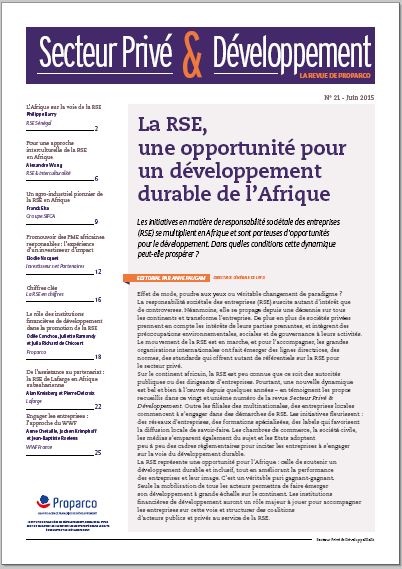
PROPARCO just released its 21st quartely publication "Private Sector and Development". This issue focuses on Corporate Social Responsibility (CSR) in Africa. As stated by Anne Pogham (CEO of the French Development Agency) in the introduction: "CSR represents a twofold opportunity for Africa. It can encourage inclusive and sustainable development while also improving companies’ performance and their image. This is a win-win situation for Africa". 


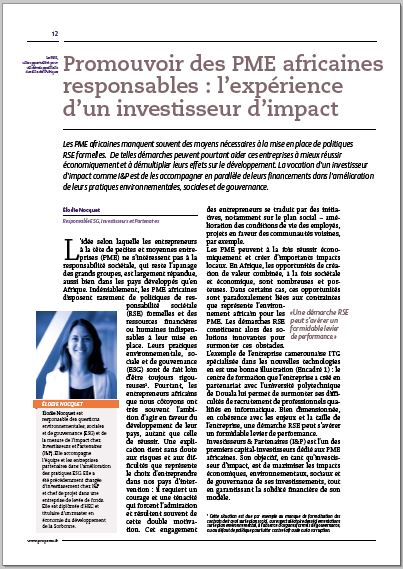
Elodie Nocquet, ESG & Impact Director at Investisseurs & Partenaires, reviews the experience of I&P regarding CSR policy in an article entitled: "Boosting CSR in African SMEs: the experience of an impact investor".

As recalled in introduction to the article, "African SMEs often lack the funding to put formal CSR policies in place, but doing could help them to achieve greater economic success and boost their impact on development. As well as providing funding, the role of an impact investor such as I&P is to support these businesses in improving their environmenta, social and governance practices".


         Download the Publication                                         Read I&P Article
              revue n°21                Article I&P


About

Private Sector & Developpement is a unique quarterly publication that provides analysis and insights into the mechanisms through which the private sector can contribute to the development of countries in the Southern hemisphere.

Created in 1977, PROPARCO is a Development Financial Institution partly held by Agence Française de Développement (AFD) and private shareholders from the North and South. PROPARCO’s mission is to be a catalyst for private investment in developing countries which targets growth, sustainable development and reaching the Millennium Development Goals (MDGs). Find out More



Proparco a annoncé la parution du 21e numéro de la revue Secteur Privé et Développement, qui s’interroge sur les enjeux de la Responsabilité Sociale des Entreprises (RSE) en Afrique, qui représente, d'après Anne Pogham (Directrice Générale de l'AFD), une "véritable opportunité, celle de soutenir un développement durable et inclusif, tout en améliorant la performance des entreprises"


Elodie Nocquet, directrice ESG & Impact chez Investisseurs & Partenaires, revient sur l’expérience d’I&P en la matière dans un article intitulé ‘’Promouvoir des PME africaines responsables : l’expérience d’un investisseur d’impact’’.

Ainsi que rappelé en introduction de l'article, "Les PME africaines manquent souvent des moyens nécessaires à la mise en place de politiques RSE formelles. De telles démarches peuvent pourtant aider ces entreprises à mieux réussir économiquement et à démultiplier leurs effets sur le développement. La vocation d'un investisseur d'impact comme I&P est de les accompagner en parallèle de leurs financements dans l'amélioration de leurs pratiques environnementales, sociales et de gouvernance"


Télécharger la Revue                                          Lire l'article d'E. Nocquet

              revue n°21                Article I&P


A propos

Secteur Privé & Développementest une revue trimestrielle destinée à confronter les opinions d'experts aux approches diverses et complémentaires sur des problématiques liées au rôle du secteur privé dans le développement des pays à bas revenus, et particulièrement d'Afrique subsaharienne.

PROPARCO est la fililale de l'Agence Française de Développement, dédiée au financement du secteur privé.  PROPARCO a pour mission de favoriser l'émergence d'un sectteur privé fort, dynamique et innovant en faveur du développement durable dans les pays du Sud. En savoir plus


For the third consecutive year, Investisseurs & Partenaires publishes its annual Environmental, Social and Governance (ESG) and Impact reporting, conceived as a comprehensive review of its fund IPAE societal strategy.

The document presents the methodology in terms of ESG policy and impact measurement and examines the main results and achievements of IPAE partner companies in 2014 (16 companies this year, including 5 new investments).


The report is divided into 4 sections :

Portfolio overview

A presentation of our ESG and impact policy;

Assessment of the fund’s impacts in 2014 ;

Update on the environmental objective, with a focus on the portfolio’s carbon footprint


Donwload the Report


A REVIEW OF IPAE PORTFOLIO, PROMOTING A NEW GENERATION OF AFRICAN ENTREPRENEURS


I&P Afrique Entrepreneurs (IPAE) is the second fund managed by Investisseurs & Partenaires. Launched in 2012, IPAE accounted 16 companies in its portfolio at end March 2015, based in 11 African countries. 64% of IPAE’s investments are located in Least Developed Countries. The investee companies operate in a great variety of sectors and provide basic goods and services for African companies or private individuals, most of them directly addressing (70%) the new Sustainable Development Goals (SDGs) (see p35).


KEY TAKEAWAYS

  • 80% of IPAE companies are led by African CEOs and 25% are women. African entrepreneurs have a significant experience in their sector prior to developing their own company (p.9). To go further on training and networking possibilities, I&P plans to create a network dedicated to the entrepreneurs (p.8).
  • Partner companies have a significant impact on their local stakeholders. They represent 1,582 jobs. More than 40% of these jobs have been created since IPAE’s investment and one-third are occupied by women (p.27). Employees benefit from decent wages (4 times above minimum wages on the average) and from basic social protection. Two-third of employees are medium skilled and 348 benefited from training opportunities in 2014 (p.32). 60% of companies suppliers are local and all the companies pay taxes to local governments, contributing to State budget for €4,6 million in 2014.
  • From an environmental point of view, the portfolio carbon footprint represent 7 381 tons of carbon dioxide equivalent in 2014, two third resulting from vehicles emissions. A transport company in Ghana (VRS) has launched a carbon offset initiative for its clients with I&P’s help and four companies have initiated energy savings projects. To set an example, I&P is offsetting its own carbon emissions with a project based on improved stoves for cooking in Côte d’Ivoire (p.16)


A RIGOROUS ESG METHODOLOGY, AS ACKNOWLEDGED BY THE IMPACT INVESTING COMMUNITY

As an impact investor, I&P endeavors to achieve economic, social and governance impacts through its investments and has therefore developed an extensive ESG and impact methodology, as detailed in the reporting. The methodology has been widely recognized by the actors of the impact investing field, as demonstrated by the good results obtained for the PRI Pilot Assessment (I&P became signatory to the UN Principles for Responsible Investment in 2013). I&P was graded “A” for the ESG overarching approach as well as for the Private Equity Module, positioning I&P in the first quartile of the PE industry (p.22-23).

After being chosen as a case study to represent the French committee for the G8 Impact Measurement Working Group, I&P impact measurement methodology is currently analyzed by the European Venture Philanthropy Association (EVPA), to complement the Practical Guideline on Impact Measurement with detailed practical examples. 


Investisseurs & Partenaires publie, pour la troisième année consécutive, son rapport sur les enjeux ESG (Environnement, Social et Gouvernance) et Impact de son portefeuille IPAE.


Le document présente notre politique ESG et méthodologie de mesure d’impact, ainsi que les principaux résultats atteints par les entreprises en 2014 (16 entreprises partenaires cette année, dont 5 nouveaux investissements)


Le rapport est divisé en 4 sections :

Vue d’ensemble du portefeuille;

Présentation de la politique ESG & Impact;

Evaluation des impacts générés en 2014 ;

Focus sur l’objectif environnemental, et la politique de compensation carbone


Télécharger le Rapport


UNE ANALYSE DU PORTEFEUILLE IPAE, METTANT EN AVANT UNE NOUVELLE GENERATION D’ENTREPRENEURS AFRICAINS


I&P Afrique Entrepreneurs (IPAE) est le second fonds géré par Investisseurs & Partenaires. Lancé en 2012, IPAE compte 16 entreprises dans son portefeuille, basées dans 11 pays africains. 64% des investissements sont situés dans des PMA (Pays les Moins Avancés). Les entreprises opèrent dans des secteurs d’activité très variés et fournissent des biens et services essentiels aux entreprises africaines locales et/ou aux individus. La plupart de ces entreprises (70%) répondent directement aux nouveaux Objectifs de Développement Durable (voir p.35).


Points Clés


  • 80% des entreprises IPAE sont dirigées par des Africains, et 25% par des femmes. Une grande majorité d’entre eux bénéficiaient d’une solide expérience avant de développer leurs propres entreprises (p.9). Afin d’approfondir les opportunités de formations et d’échanges, I&P est en train de mettre en place un réseau dédié aux entrepreneurs (p.8).
  • Les entreprises partenaires ont un impact significatif sur leurs parties prenantes. Elles représentent 1 582 emplois au total. Plus de 40% de ces emplois ont été créés après l’investissement d’IPAE et un tiers d’entre eux sont occupés par des femmes (p.27). Les employés bénéficient de salaires décents (en moyenne 4 fois plus élevés que le salaire minimal national) et d’une protection sociale. Deux tiers des employés sont moyennement qualifiés et 348 ont pu suivre des formations en 2014 (p.32). 60% des fournisseurs sont locaux, et toutes les entreprises contribuent au budget de l’Etat (4,6 millions € d’impôts payés en 2014).
  • Sur les questions environnementales, l’empreinte carbone du portefeuille s’élève à 7 381 tonnes en 2014, dont deux tiers résultent des émissions des véhicules. L’entreprise ghanéenne VRS développe une stratégie de compensation carbone et quatre entreprises ont initié des projets d’économies d’énergie. I&P compense ses propres émissions carbones en finançant un projet de foyers améliorés en Côte d’ Ivoire. 


UNE METHODOLOGIE ESG RIGOUREUSE, RECONNUE PAR LES PROFESSIONNELS DU SECTEUR


I&P attache une importance particulière aux impacts générés à travers ses investissements et a donc développé une méthodologie ESG et Impact approfondie, présentée dans le rapport. Cette méthodologie a été largement reconnue par les acteurs de l’impact investment, comme le montre les très bons résultats obtenus lors de l’évaluation PRI (Principles for Responsible Investments). I&P a été noté ‘’A’’ dans les modules ‘’approche ESG’’ et ‘’capital investissement’’, et est ainsi classé dans le quartile supérieur des sociétés de capital-investissement (p.22-23).


Après avoir été sélectionnée comme cas d’étude par le G8 Impact Measurement Working Group, la méthodologie de mesure d’impact d’I&P est actuellement étudiée par la European Venture Philanthropy Association (EVPA) afin de compléter le ‘’Guide Pratique pour la Mesure et la Gestion de l’Impact’’


The Ferdi (Foundation for International Development Research and Study) gathered the contributions of more than 40 authors, selected from amongst the leading international experts from the North and the South, in the newly released book "Financing Sustainable Development - Addressing Vulnerabilities".

Jean-Michel Severino, President of Investisseurs & Partenaires, and Pierrick Baraton, Research Officer, publish an article putting forward the rise of impact investment as a major innovation in view of the 'post-2015' agenda.


Presentation of the Book

The new international development agenda, with global public goods featuring prominently, is setting a course for universal sustainable development. Achieving the new Sustainable Development Goals (SDGs) will require the mobilisation and allocation of a huge amount of public and private resources. This book examines how finance can help to ensure the sustainability of development by taking into account the various types of vulnerabilities faced by developing countries.

Structured around the three dimensions of sustainability – economic, social and environmental– this collection of complementary contributions outlines how new development finance can help to tackle vulnerabilities and thus promote sustainability. The book highlights the role of new types of finance, as well as the continuing relevance of public development assistance for the poorest and most vulnerable countries. It emphasises the need for differentiated funding mechanisms according to the characteristics of the recipient countries and the challenges they face.

Discover the Summary


Focus on Impact Investment

If the book underlines the importance of Official Development Aid, especially for the poorest and most vulnerable countries, it also highlights the role of new types of investments, able to bring innovative solutions to development challenges.

J.-M. Severino and P. Baraton put the focus on the 'nascent category of impact investment", which is likely to "form, over the coming decade, a class of highly significant  assets able to play a major role in development aid and in the management of global public goods."


► Download the article


About the Ferdi

The mission of the Foundation for International Development study and Research is to promote a fuller understanding of international economic development and the factors that influence it. With its network of over 150 experts, Ferdi supports research activities that use the most directly relevant instruments and methods to study developement and strenghten the potential of the French-speaking world in this area. 



La Ferdi (Fondation pour les Etudes et Recherches sur le Développement International) publie un ouvrage collectif sur le financement du développement durable.

Il réunit quarante-sept auteurs choisis parmi les meilleurs experts internationaux et de hautes personnalités du Nord et du Sud, parmi lesquels figure Jean-Michel Severino, président d’Investisseurs & Partenaires. Il a co-écrit, avec Pierrick Baraton, chargé d’étude chez I&P, un article mettant l’accent sur l’essor de l’impact invesment comme innovation majeure dans la perspective de l'agenda post 2015.


Présentation de l'ouvrage

‘’Pour parvenir à un développement durable, il faut traiter l’ensemble des vulnérabilités qui touchent les pays les plus pauvres, essentiellement situés en Afrique, vulnérabilités économiques, sociopolitiques et environnementales’’ assure Patrick Guillaumont, président de la Ferdi.

L’ouvrage examine ainsi comment le financement du développement peut permettre d’en assurer la durabilité en prenant en compte les différentes formes de vulnérabilité qui la menacent. Il est structuré selon les trois dimensions de la durabilité évoquée – économique, sociale et environnementale. Découvrir le sommaire


Il pointe les débats qui agitent aujourd’hui la communauté internationale, notamment : quel rôle pour les pays émergents dans le financement du développement ? Comment l’aide publique au développement doit-t-elle être définie et dépensée ? Quelle fiscalité adopter pour que les activités minières profitent au développement des plus pauvres ? Comment promouvoir « l’impact investment » ? Comment mettre en œuvre le financement visant à l’adaptation au changement climatique et à son atténuation ? Comment dépenser utilement dans les Etats fragiles ?


Focus sur l'Impact Investment

Tout en rappelant l’importance persistante de l’aide publique au développement pour les pays les plus pauvres et vulnérables, l’ouvrage met en avant le rôle de nouveaux types de financement, soulignant la nécessité d’une différenciation des instruments de financement selon les caractéristiques des pays bénéficiaires et la nature des défis auxquels ils font face.

Pour reprendre la formule du Point Afrique, ‘’Jean-Michel Severino se fait l’avocat de l’impact investment en Afrique’’ dans l’article co-écrit avec Pierrick Baraton et intitulé ‘’Camarades développeurs, encore un effort pour plus d’impact !’’. L’impact investment représente ainsi ‘’une innovation réelle dans le sens où un investissement est valorisé, prenant en compte les externalités qui ne sont pas capturées par sa performance financière’’.

Télécharger l'article (en anglais)


En savoir plus


A propos de la Ferdi

Créée en 2003, la Fondation pour les Etudes et les Recherches sur le Développement International est un Think tank dont la mission première est, sur la base de ses travaux de recherche, de participer et d’influencer le débat international sur les grandes questions de développement. Institution privée, sans but lucratif et indépendante, elle mobilise des chercheurs de haut niveau dans le domaine du développement et propose une réflexion pertinente et novatrice sur des thématiques clés de l’économie du développement.

La Ferdi développe des outils d’analyse innovants et soutient les activités de recherche utilisant les instruments les plus modernes et les plus pertinents de de la science économique pour l’étude du développement. Elle est particulièrement active sur les questions liées au financement du développement, la vulnérabilité des pays en développement et l’intégration régionale en Zone franc.


CDS, a compagny offering access to water and electricity services to rural population in Mauritania, has partnered with Djikké, a savings and credit mutual, so as to propose adequate solar equipment via microfinance solutions.

The partnership will allow CDS to develop its activities in rural areas, where electricity access is particularly limited. The company is part of IPDEV portfolio since 2011. To find out more, please visit their website or watch the reportage made by Joan Bardeletti for the project Small is Powerful.


A good knowledge of Mauritania's rural areas

Settled in Nouakchott and in rural areas, Djikké offers financial services (saving, credit, money transfers) and non-financial services (literacy, awareness campaigns) to its clients.

Both CDS and Djikké developped strong relationships with their clients living in rural areas. According to their experience, the lack of access to electricity services appears as a major obstacle to local developement and to the improvement of living conditions


Address the  lack of access to energy services in Mauritania

Energy access is a major issue in Mauritania: electrification rate is about 30% at the national level, but with a huge gap between urban and rural areas. Only 5% of the rural population has access to electricity.

Access to solar equipment is impeded by two major obstacles:

  • Lack of information to select reliable and good-quality equipment
  • Lack of financing solutions to invest in these equiments

Through this partnership, Djikké will propose CDS' solar products and an adequate credit solution for its clients (about 12,000 in rural areas)

CDS - Photo

Children are studying in the evening thanks to a solar lamp provided by CDS, in the village of Bjelware. Photo Credit: Joan Bardeletti


CDS, entreprise proposant un accès aux services d’eau et d’électricité aux populations rurales de Mauritanie, a engagé un partenariat avec la mutuelle d’épargne et de crédit Djikké afin de proposer des solutions solaires adaptées via la microfinance.


Le partenariat va ainsi permettre à CDS de développer ses activités en zone rurale, où l’accès à l’électricité est le plus limité. L’entreprise a rejoint le portefeuille I&P Développement en 2011. Pour en savoir plus, visitez le site de l’entreprise et le reportage réalisé par Joan Bardeletti pour le projet Les Grands Moyens.


Deux acteurs engagés en milieu rural

Présente à Nouakchott et en milieu rural, Djikké offre à ses adhérents des services financiers (épargne, crédit, transfert d’argent) et non-financiers (alphabétisation, sensibilisation).

CDS et Djikké sont tous deux proches de leurs clients et adhérents en milieu rural, et ont identifié le manque d’accès à l’électricité comme l’un des freins majeurs à l’amélioration des conditions de vie des populations et au développement économique local.


Répondre au difficile accès à l’énergie en Mauritanie

L’accès à l’électricité constitue en effet un enjeu majeur en Mauritanie : le taux d’électrification est estimé à 30% au niveau national, avec une très forte disparité géographique. Ainsi, seuls 5% de la population rurale ont accès à l’électricité.  

L’accès aux équipements solaires, particulièrement adaptés en Mauritanie, est confronté à deux obstacles majeurs :

  • Le manque d’information pour sélectionner les solutions solaires fiables et de bonne qualité
  • Le manque de solutions de financement pour ces investissements, sachant que les équipements solaires ont souvent un coût initial plus élevé par rapport à d’autres sources énergétiques, largement compensé à moyen terme

A travers ce partenariat, Djikké va ainsi proposer les produits solaires CDS et une solution de crédit adaptée à ses adhérents (environ 12 000 en zone rurale).

CDS - Photo

Des enfants étudient en soirée avec une lampe solaire de CDS, dans le village de Bjelware. crédit photo: Joan Bardeletti


Pour en savoir plus


Investisseurs & Partenaires partnered with the working group led by CERISE to define what is a social business and to develop an analytical framework to asssess the practices of social businesses.

The group has conducted a in-depth study on 9 social enterprises operating in diferent sectors and geographic areas, among which feature two companies supported by I&P: Nutrizaza and PhiléoL.

► Visit the website


CERISE and its partners have developped a free tool, the "Social Business Scorecard" to manage the social performance of social businesses. The scorecard is structured around 7 key dimensions in terms of social entrepreneurship:

  1. The Purpose: a social business has a clear social mission, shared by all stakeholders
  2. Public: a social business targets a public that is vulnerable, poor and/or excluded  (clients, suppliers and/or employees)
  3. Products and Services: a social business offers and adapted product mix that meets basic needs and reduce inequalities
  4. HR Policies: a social business has policies and practices that ensure employees and service providers are treated responsibly
  5. Ethical Principles: a social business adheres to ethical principles regarding the environment, the community and integrity
  6. Profits: a social business has a defined and transparent policy on profits and how they are used to further the social mission
  7. Partnerships (optional): when a social business benefits from a partner relationship, the technical support provided is fundamental to the business model


Since May 2012, CERISE had led a working group composed of its members (CIDR, GRET, IRAM) and partners (AIDR, Entrepreneurs du Monde, French Agency of Development - AFD  - and the DFI PROPARCO, the foundation Grameen Credit Agricole and Investisseurs & Partenaires)


The detailed study of the company Nutrizaza, supported by I&P since 2012, is available on the website.

Nutrizaza is a social business aiming at the development of a network of baby restaurants alongside with the commercial selling of "Koba Aina", an enhanced baby flour complementary with breast-feeding. The company seeks for the largest distribition of a good quality aliment for infants, and especially among the poorest while stricking to an enterprise-based approach as a financially sustainable business. Nutrizaza has also undertaken a campaogn against malnutrition through information campaigns and a watch over the babies' weight.

► Download the Study (in French)


Presentation of the company


About CERISE

CERISEis a knowledge exchange newtork for microfinance practitionners. Founded in 1998, CERISE is richly diverse, bringing together a variety of practitioners, researchers, donors and investors from the North and the South. Their work if focused on four themes: (1) Impact and Social Performance; (2) Agricultural and rural finance; (3) Governance and social viability; (4) Intervention Methods. In each of these areas, CERISE gathers the experience of its members and in some cases develop opetional tools so as to create alliances and synergies throughout the microfinance sector.

Visit their Website


Investisseurs & Partenaires s’est associé au groupe de travail constitué par le réseau CERISE afin de favoriser la caractérisation du Social Business et concevoir une grille d’analyse permettant l’évaluation des entreprises sociales.

Le groupe a conduit une étude approfondie de 9 entreprises sociales opérant dans différents secteurs et zones géographiques, parmi lesquelles figurent deux entreprises partenaires d’I&P : Nutrizaza et PhiléoL.

► Visitez le Site

► Lire le travail de Synthèse


"Social Business Scorecard"

CERISE et ses différents partenaires (voir ci-dessous) ont élaboré une grille d’analyse ‘’Social Business’’, composée de dimensions indépendantes permettant de prendre en compte un ensemble d’éléments structurants pour l’entrepreunariat social :

  1. Le Projet : une vision claire et partagée des objectifs sociaux et économiques
  2. Le Public: une cible vulnérable, pauvre et/ou exclue (clients, fournisseurs et/ou salariés)
  3. Les Produits et Services : adaptés pour répondre à des besoins essentiels et réduire des inégalités
  4. Les Politiques RH : traitement responsable des employés et prestataires clés
  5. Les Principes éthiques : responsabilité envers l’environnement, envers la communauté et intégrité dans la conduite de l’organisation
  6. Le Profit : transparent, encadré, au bénéfice de la mission sociale
  7. Les Partenariats : support technique essentiel qui garantit la solidité du modèle


Structurée autour de ces 7 dimensions essentielles (les ‘’7 P’’), la grille est composée d’une vingtaine de critères et d’une cinquantaine de pratiques. L’analyse permet de produire un rapport sur les 7 ‘’P’’ intégrant une représentation graphique du profil de l’entreprise sociale. Cet outil permet de faciliter l’évaluation, l’orientation stratégique et opérationnelle et la communication interne et externe.


CERISE coordonne un groupe de travail composé de  ses membres (le CIDR, Centre International de Développement et de Recherche, le GRET et l’IRAM) et ses partenaires (AIDR, Alliance Internationale de Développement et de Recherche, l’association Entrepreneurs du Monde, l’Agence française de développement AFD et sa filiale dédiée au secteur privé, PROPARCO, La fondation Grameen Crédit Agricole et le groupe Investisseurs & Partenaires)


Cas d'étude sur Nutrizaza


L’entreprise malgache Nutrizaza, soutenue par I&P depuis 2012, a fait l’objet d’une analyse détaillée actuellement disponible sur le site de Cerise.

Nutrizaza est une entreprise à vocation sociale dont l’objet est de développer un réseau de restaurants pour bébés (hotelin’jazakely) ; et de développer l’activité de commercialisation d’aliments pour bébé, notamment le « Koba Aina ». Elle cherche à rendre le produit accessible à tous, et en priorité aux familles défavorisées, tout en développant une activité entrepreneuriale, soutenable financièrement. Nutrizaza met également à disposition des familles un espace de contrôle de santé des enfants avec une pesée régulière et assure une surveillance face à la sous-nutrition.

► Téléchargez la synthèse de l'étude


 Présentation de Nutrizaza:


A propos de CERISE

CERISE est un réseau d’échange sur les pratiques en microfinance. Quatre thèmes constituent le fil conducteur de leur travail : (1) l’impact et les performances sociales, (2) le financement de l’agriculture et du secteur rural, (3) la gouvernance des institutions de microfinance et (4) les modes d’intervention en microfinance. CERISE a pour objectif de produire des outils opérationnels et de faire progresser les pratiques en microfinance

► Site internet


On the 23rd of June, several EVPA members gather in Paris for a site visit at Investisseurs & Partenaires.

Twice a year, EVPA (European Venture Philanthropy Association) organizes site visits in one of its member organizations. These visits are conceived as an opportunity to look behind the scenes of an experienced venture philanthropy organization. I&P team have therefore agreed to share their experience in supporting social enterprises, focusing mainly on their impact measurement and management approach. Find out more on EVPA's website


Program

09:00-09:30  Welcome and Introduction round

Speakers: Jean-Michel Severino, CEO, I&P; Elena Balestra, Community Manager, EVPA


09:30-12:30  I&P their journey in Venture Philanthropy and Social Investment


09:30-10:15  Presenting the model of I&P

Speaker: Jean-Michel Severino, CEO, I&P


10:15-11:00  I&P new challenge: establishing a network of 10 –in-country investment funds and disseminate the Private Equity best practices in Africa

Speaker: David Munnich, Head of IPDEV 2, I&P


11:15-12:30  I&P Impact Measurement approach: an introduction

Speaker: Elodie Nocquet, Head of ESG Issues, I&P


13:30-14:00 Investments showcase

Speaker: Emilie Debled, Communications and Public Relations Officer, I&P


14:00-15:15 Impact measurement: evolution towards a tailored system: lessons learnt and recommendations
Speakers: Elodie Nocquet, Head of ESG Issues, I&P; Saskia van Alphen, Program Manager, Noaber Foundation; Lisa Hehenberger, Research and Policy Director, EVPA


15:30-17:00  Active group discussions

Moderator: Elena Balestra, Community Manager, EVPA

Participants will be divided into groups to discuss their challenges in measuring and managing impact with the aim of presenting the results of their working group to the other participants


17:00-17:30  Evaluation & Closing


Download the Program


About EVPA


EVPA is a membership association made up of organisations interested in or practising venture philanthropy and social investment across Europe. Established in 2004, the association aims to be the home as well as the highest-value catalytic network of European social investors, venture philanthropists and foundations committed to using venture philanthropy and social investment tools to target societal impact.

Currently the association has over 180 members from 25 countries, mainly based in Europe, but also outside Europe, such as Turkey, United Arab Emirates and Asia, showing the sector is rapidly evolving across borders.

Visit their website


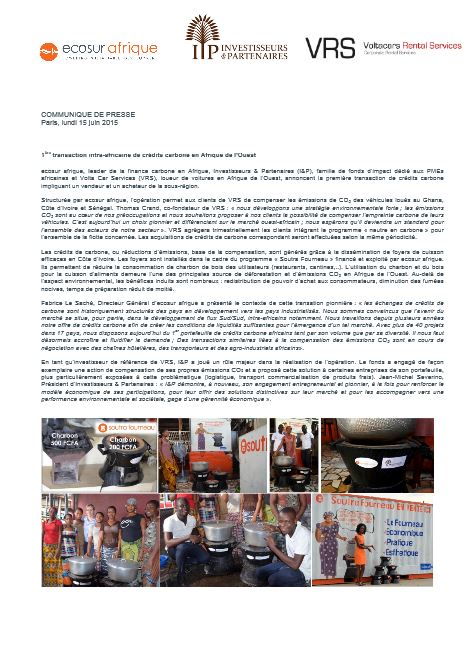
The long-term rental company VRS, based in Ghana, is developing a strong environmental strategy thanks to a carbon and chooses to offset its carbon footprint with the support of Investisseurs & Partenaires and Ecosur Afrique, the leading carbon finance group in Africa. According to Jean-Michel Severino, this project demonstrates I&P's ability to "strengthen the business model of its holdings, offering them distinctive solutions in their market and allowing them to improve their environmental and social performance".


The press release published by Ecosur Afrique (available online)

Ecosur Afrique, the leading carbon finance group in Africa, Investisseurs & Partenaires (I&P), an impact investment fund dedicated to small and medium size enterprises in Sub-Saharan Africa and Voltacars Rental Services (VRS), a car leasing company operating in West Africa, today announced the first ever carbon credits transaction involving a Seller and a Buyer from West Africa.

 
The transaction, which has been structured by ecosur afrique, allows VRS customers to offset the CO2 emissions of vehicles leased in Ghana, Côte d’Ivoire and Senegal. Thomas Crand, the co-founder of VRS, states: "We develop a strong environmental strategy; CO2 emissions are at the heart of our concerns and we are pleased to offer our customers the option to offset their carbon footprint. Today’s transaction is pioneering and a unique choice, which distinguishes us on the West African market. We hope it will become standard in our sector." VRS will aggregate the offset demand of customers taking part in the "carbon neutral" program each quarter and for the whole fleet concerned. The carbon credit purchases will be made with same periodicity.
 
The carbon credits, or emission reductions, which are at base of the offset transaction, are generated from the dissemination of energy efficient cook stoves in Côte d’Ivoire. The cook stoves are distributed as part of the "Soutra Fourneau" programme financed and operated by ecosur afrique. They allow to reduce charcoal consumption of small entrepreneurial users such as restaurants or canteens. The use of charcoal and firewood for cooking purposes remains a major source of CO2 emissions and deforestation in West Africa. Beyond the environmental aspect, the benefits are numerous: redistribution of purchasing power to consumers, decrease of noxious fumes, reduction of meal preparation time by half.
 
Fabrice Le Sache, CEO of ecosur afrique explains the background of this pioneering transation: "The exchange of carbon credits involves traditionally their transfer from developing countries to industrialized countries. We are convinced that the future of the market lies in part in the development of the South / South transactions, particularly within Africa. We have been working for several years on our carbon credit offer in order to create sufficient liquidity allowing the emergence of such a market. With over 40 projects in 17 countries, we now have the largest portfolio of African carbon credits in terms of volume and diversity. We must now increase and expand the demand; Similar CO2 offset transactions are under negotiation with African hotel chains, carriers and agribusinesses."
 
As a private investor of VRS, I&P played a major role in the operation. The fund began by offseting its owns CO2 emissions in an exemplary manner and proposed this solution to some companies in its portfolilo in the following, particularly to those, which are concerned by this topic (logistics, transport, distribution of fresh products). Jean-Michel Severino, CEO of Investisseurs & Partenaires: "I&P shows, once again, its commitment to pioneering entrepreneurial ideas, both to strengthen the business model of its holdings, to offer them distinctive solutions in their market and to assist them in environmental and social performance, a pre-condition of economic sustainability."
 

Downoad the Press Release

Communiqué Ecosur

Press Review